Oxidation Timeline for Decanted Whiskey
Whiskey does not have a fixed expiration date once transferred to a decanter. Changes depend more on the stopper, air space, temperature, light, and pouring frequency than on elapsed time alone; oxidation is only part of the process.
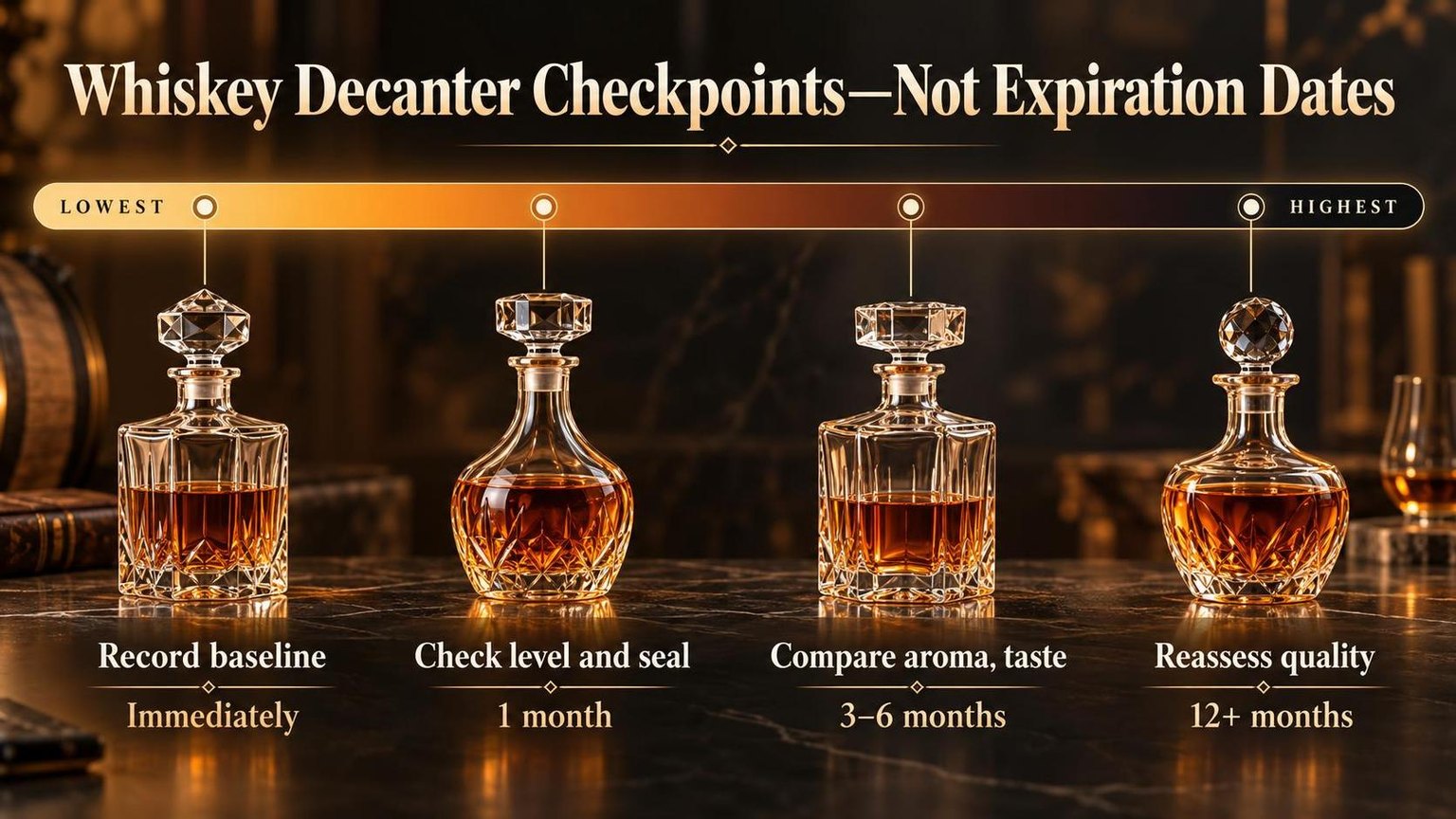
Practical Checkpoints, Not Expiration Dates
The following intervals are inspection checkpoints, not experimentally established shelf-life limits. They assume a clean, dry, lead-free glass decanter stored upright, away from sunlight and heat, with a stopper that seals securely.
| Time after decanting | What to check | What the interval means |
| Immediately | Record the fill level, aroma, and stopper fit. | This establishes a baseline; transferring whiskey does not start a predictable countdown. |
| 1 month | Look for unexplained liquid loss and assess the seal. | A poor closure can matter before obvious flavor changes appear. |
| 3–6 months | Compare aroma and taste with your initial notes. | Consider a smaller bottle if the decanter now contains substantial air space. |
| 12 months and beyond | Reassess storage conditions and sensory quality. | Elapsed time alone cannot establish whether the whiskey has deteriorated. |
Why the Rate Varies
Decanting exposes whiskey to air during pouring and leaves oxygen in the headspace. Subsequent openings replenish that air.
However, a decanter’s flavor changes can also involve evaporation and the loss or redistribution of volatile aroma compounds, rather than oxidation alone.
A loose decorative stopper creates an exchange pathway with the room. Both alcohol and water can escape; the resulting change in strength depends on storage conditions.
A visible decline in liquid level without pouring signals a closure problem, not a measurable oxidation rate.
Headspace matters, but bottle geometry and opening frequency complicate predictions. There is no reliable formula that converts a particular fill level into a remaining number of months.
Claims that every decanter keeps whiskey unchanged for a precise period overstate the evidence.
How to Preserve the Remaining Whiskey
- Prioritize the seal. Use a spirit-compatible closure that fits tightly. A heavy glass stopper is not automatically airtight.
- Reduce prolonged exposure. Replace the stopper promptly after serving and keep the decanter away from windows, radiators, and display lighting that generates heat.
- Downsize when practical. Transfer a dwindling quantity into a smaller, tightly sealed glass bottle rather than repeatedly opening a mostly empty decanter.
- Judge quality separately from safety. Fainter aromas or a flatter finish indicate sensory deterioration, not proof of microbial spoilage. Suspected contamination requires a separate assessment.
Whisky.com’s storage guidance supports cool, dark storage, secure closures, and smaller bottles for reduced quantities: https://www.whisky.com/knowledge/about-whisky/storage.html.
These are preservation principles, not controlled evidence for a universal decanter deadline.
How Decanter Seal Quality Changes Shelf Life
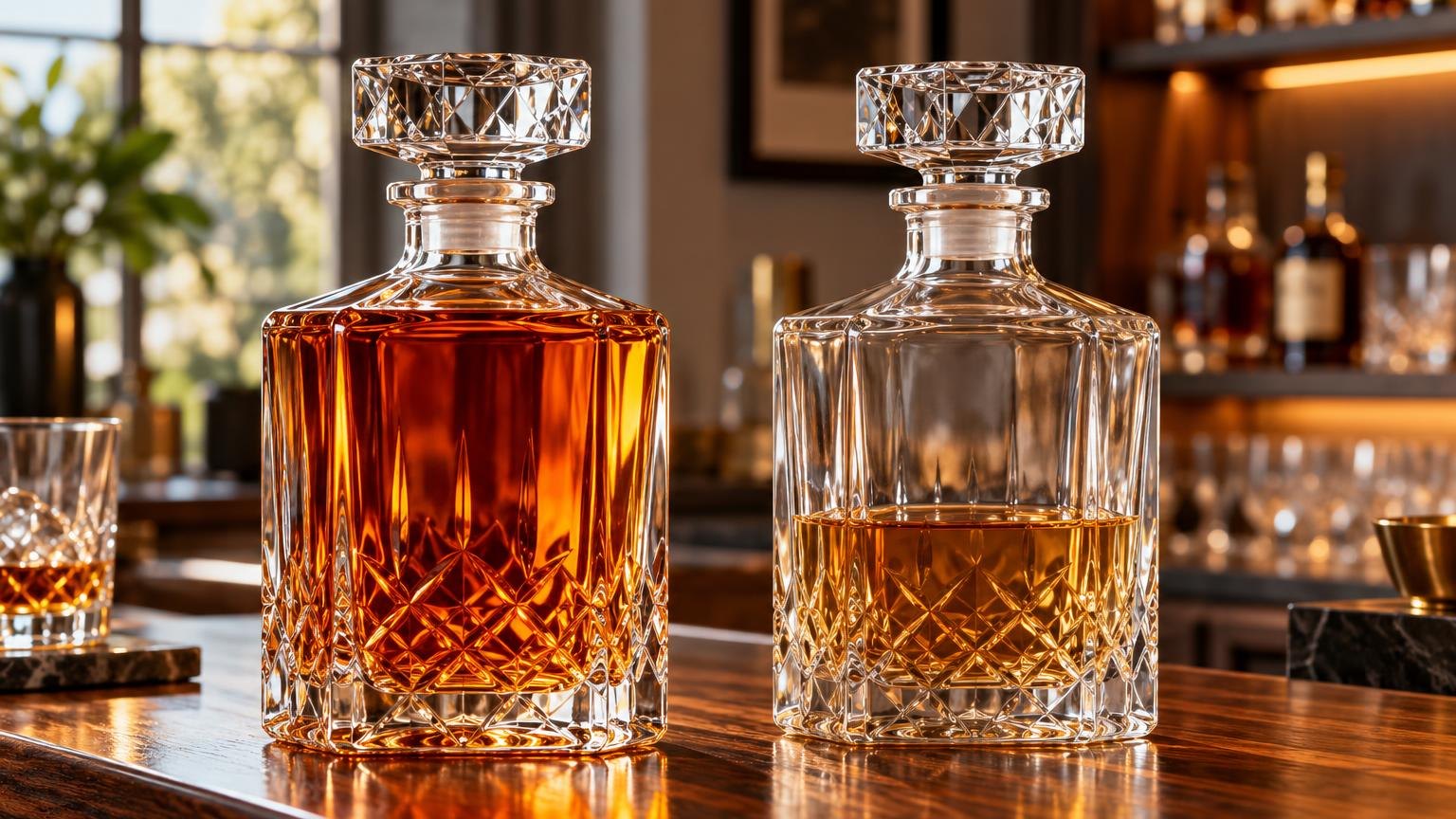
A decanter’s seal affects how quickly whiskey loses aroma and changes character. A tight closure limits air exchange and evaporation; a loose stopper can make the decanter unsuitable for extended storage, even when the glass looks expensive.
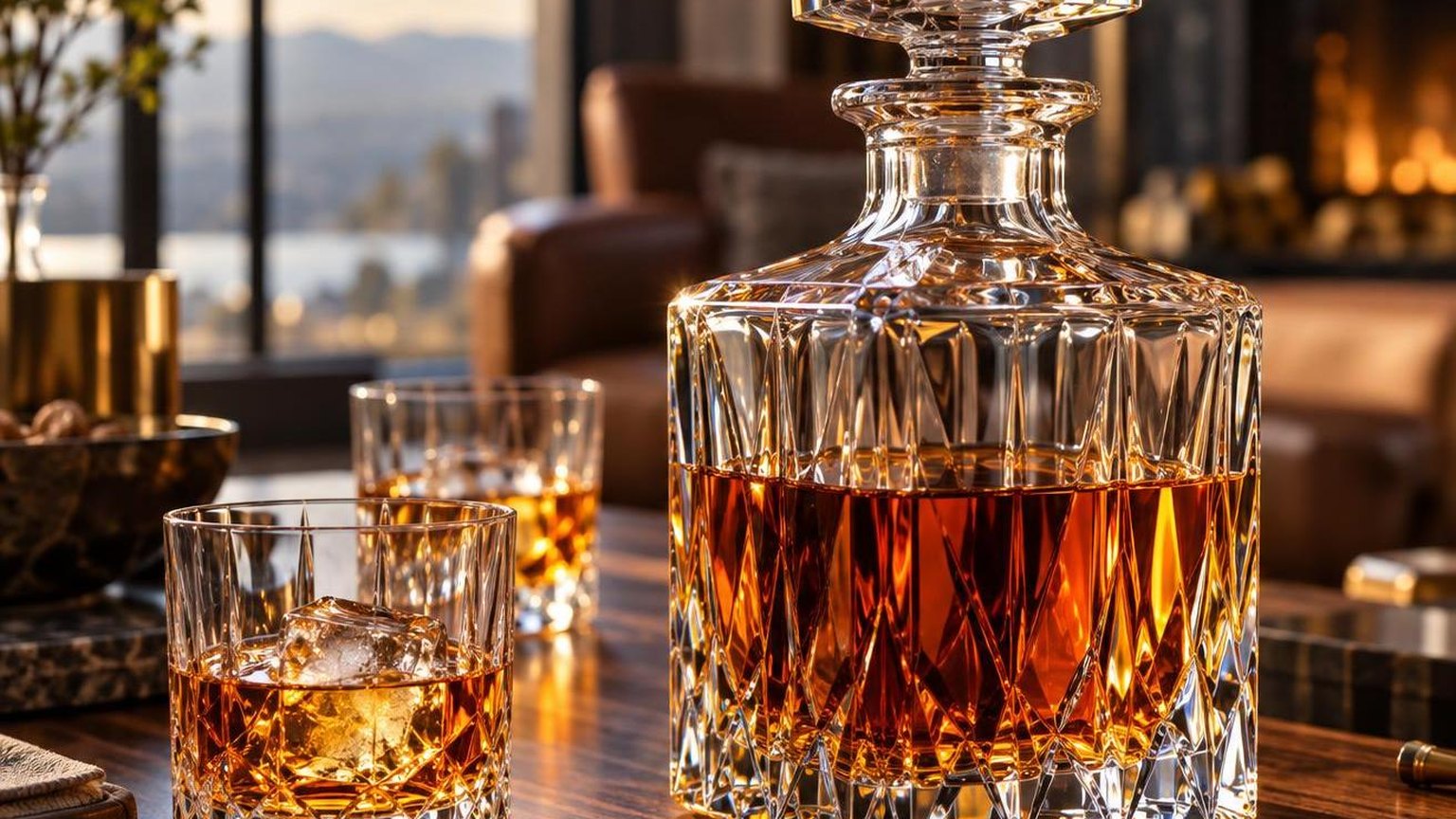
A Tight Seal Preserves Flavor, Not a Fixed Expiration Date
Whiskey does not acquire a scientifically established shelf life simply because its stopper is glass, cork, or silicone. Fit, closure condition, temperature, sunlight, and remaining liquid all matter.
Stopper material alone cannot support a reliable expiration date.
U.S. whiskey must generally be bottled at a minimum of 40% alcohol by volume under 27 CFR § 5.143. At normal bottling strength, flavor deterioration—not ordinary microbial spoilage—is the main storage concern.
An imperfect seal allows volatile compounds and alcohol-water vapor to escape.
| Closure type | What affects protection | Storage implication |
| Ground-glass stopper | Matching surfaces must seat closely without rocking. | A well-fitted stopper can work; glass construction alone does not establish airtightness. |
| Natural cork stopper | Cracks, shrinkage, crumbling, and poor sizing compromise contact. | Replace damaged cork rather than assuming it still seals. |
| Synthetic stopper or gasket | An intact, correctly sized seal must compress against the opening. | Potentially effective, but wear and unsuitable materials can undermine performance. |
| Loose decorative stopper | Visible gaps or wobbling permit easier exchange with room air. | Use for serving rather than ongoing storage. |
Check Performance Instead of Trusting Appearance
Seat the stopper normally and check for movement. Inspect cork for splits and gaskets for deformation. A stopper that feels snug offers useful evidence of fit, but this is not a laboratory leak test or proof of an oxygen-tight closure.
- Mark the fill level externally and note the date. Check it without pouring; an unexplained decline suggests evaporation or leakage.
- Keep the decanter upright, away from direct sunlight, radiators, and repeated temperature swings.
- Use a replacement closure intended for beverage contact. Avoid improvised adhesives, sealants, or materials that could contaminate the spirit.
- Transfer whiskey to a sound, tightly capped bottle if the stopper loosens or the aroma noticeably weakens.
More empty space means more air already inside the vessel. A good seal limits additional exchange; it cannot remove that headspace.
Opening the decanter repeatedly also replenishes the air, so a reliable stopper cannot eliminate every source of flavor change.
Separate Seal Quality From Glass Safety
A tight stopper does not make lead crystal appropriate for long-term storage. FDA guidance warns that lead can migrate from lead crystal into beverages.
Choose lead-free glass, and keep valuable or slowly consumed whiskey in its original, securely closed bottle.
Sources: 27 CFR § 5.143, whiskey standards of identity; U.S. Food and Drug Administration guidance on lead in food and food-contact products. These establish alcohol-strength and material-safety facts, not validated decanter storage deadlines.
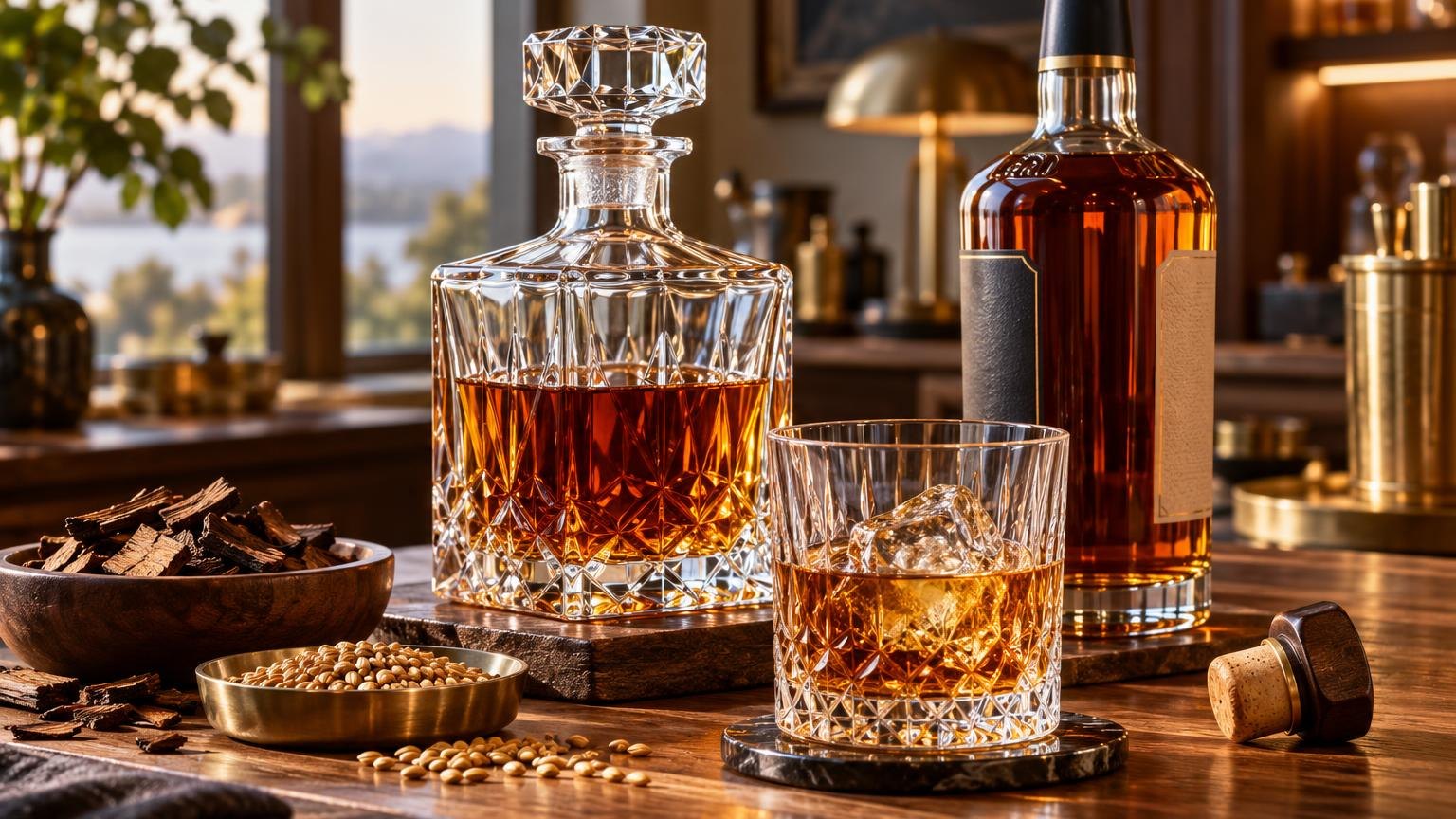
Fill Level and Headspace Accelerate Oxidation
A partly empty decanter gives whiskey more contact with an air reservoir, but fill level alone cannot predict its remaining flavor life.
A larger headspace increases potential oxygen exposure; the stopper, opening frequency, temperature, and storage time determine how much that exposure matters.
What Changes as the Decanter Empties
Headspace is the space between the whiskey’s surface and the closure. Ordinary dry air contains approximately 21% oxygen by volume, according to Encyclopaedia Britannica.
As whiskey leaves the decanter, air replaces it, increasing the oxygen potentially available above the remaining liquid.
The table models a decanter with a 750 mL internal capacity. Oxygen volumes are rounded estimates for fresh air occupying that headspace, not measurements of dissolved oxygen or predictions of flavor deterioration.
| Whiskey remaining | Headspace | Approximate oxygen in fresh headspace air |
| 675 mL | 75 mL | 16 mL |
| 375 mL | 375 mL | 79 mL |
| 150 mL | 600 mL | 126 mL |
Actual headspace also contains water and ethanol vapor, and its oxygen content changes through gas exchange and chemical reactions.
These calculations illustrate the size of the air reservoir; they do not establish an oxidation rate or a reliable countdown to stale whiskey.
Oxygen Exposure Is Not the Only Mechanism
Oxygen can dissolve into whiskey and participate in reactions involving flavor compounds. However, whiskey does not behave like opened wine: its composition and alcohol concentration differ substantially.
There is no universal headspace threshold at which a decanter’s contents suddenly become undrinkable.
Aroma changes also involve volatile compounds moving between liquid and headspace. Opening the decanter allows some vapor to escape and fresh air to enter.
A loose stopper permits continuing exchange, so a nearly full, poorly sealed vessel can still perform badly.
Headspace volume and liquid surface area are different variables. Decanter shape determines the exposed surface, which influences gas transfer.
Consequently, twice the headspace does not necessarily mean twice the oxidation, and a wider vessel does not automatically have a shorter, measurable shelf life.
Reduce Headspace Without Creating Other Problems
- Transfer a dwindling supply into a smaller, clean, dry glass bottle with a tight-fitting closure. Choose lead-free glass for storage.
- Leave space beneath the closure rather than filling to the brim. Temperature changes can expand the liquid and cause leakage.
- Keep the container upright, away from sunlight and heat. Avoid opening it repeatedly merely to check its condition.
- Label the transfer date and assess aroma and taste before serving. Treat fading character as a quality issue, not proof of microbial spoilage.
Source: Encyclopaedia Britannica, “Air,” documents atmospheric composition: https://www.britannica.com/science/air. The table uses that composition for illustrative calculations; it does not represent experimental whiskey shelf-life data.
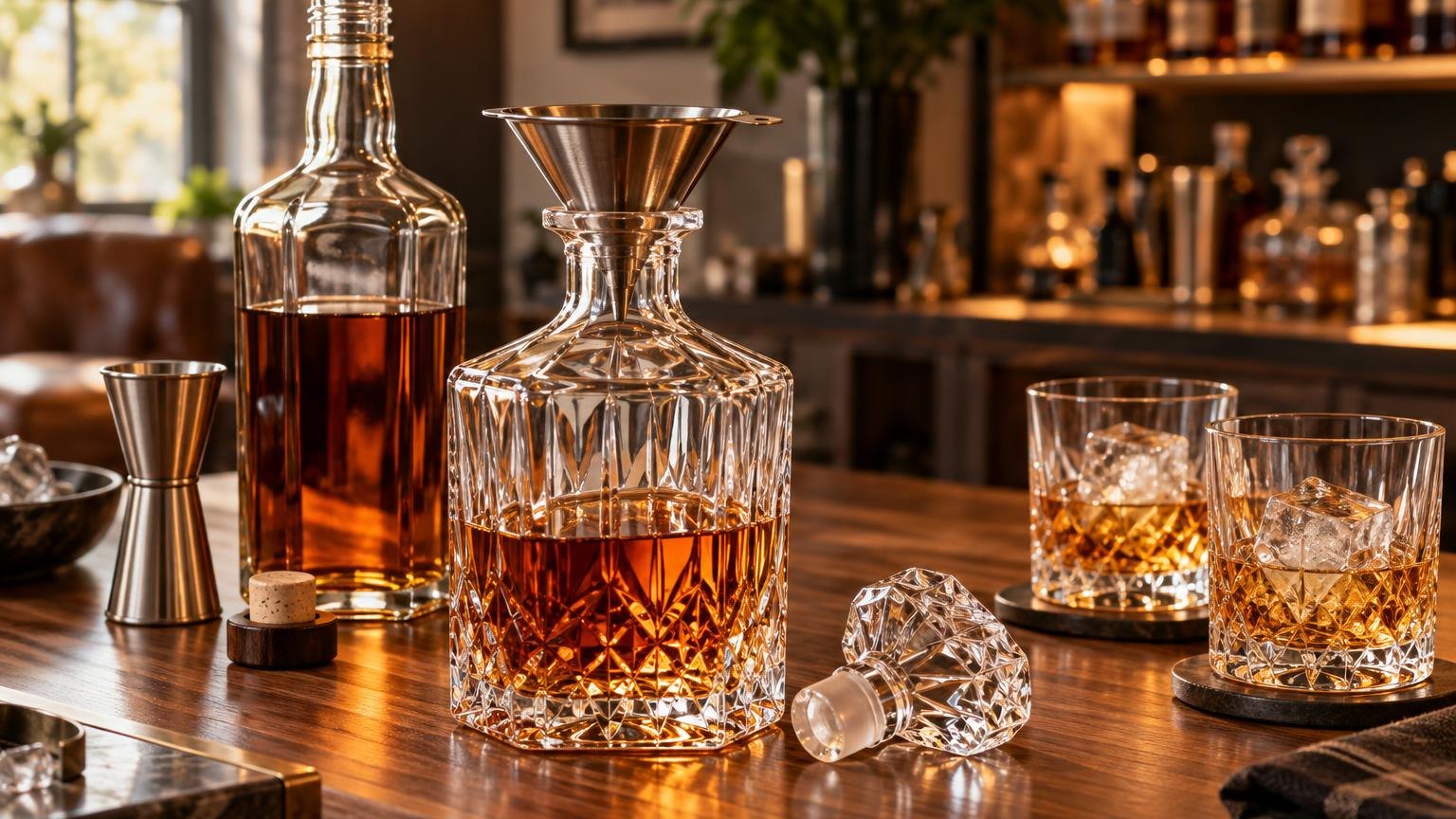
Why Higher ABV Whiskey Lasts Longer
Higher-ABV whiskey has a larger alcohol reserve, but that does not guarantee a longer life in a decanter. Alcohol helps resist microbial growth; preserving aroma and flavor depends more on the stopper, headspace, temperature, and light exposure.
More Alcohol Means a Bigger Reserve
ABV means alcohol by volume. U.S. regulations require whiskey to be bottled at a minimum of 40% ABV, although cask-strength releases can contain substantially more ethanol. The following comparison shows alcohol content, not predicted storage life.
| Whiskey strength | Ethanol equivalent per 100 mL | Storage implication |
| 40% ABV | 40 mL | Already inhospitable to most foodborne microbes; aroma can still deteriorate. |
| 60% ABV | 60 mL | More ethanol in the same volume, but no established decanter-life multiplier. |
Source: Alcohol and Tobacco Tax and Trade Bureau whiskey standards, 27 CFR § 5.143. These standards establish bottling strength, not expiration dates. https://www.ecfr.gov/current/title-27/section-5.143.
Microbial Stability Is Not Flavor Stability
Ordinary whiskey generally becomes disappointing before it becomes microbiologically unsafe under normal storage conditions. Its alcohol concentration makes growth difficult for most foodborne bacteria.
Higher strength adds antimicrobial pressure, but standard-strength whiskey already has substantial protection.
That protection does not stop volatile aromas from escaping or prevent chemical changes involving oxygen. Whiskey can lose its fresh fruit notes, smell flatter, or develop a less balanced profile without becoming a microbial spoilage problem.
Do not interpret high ABV as sterilization. Keep the decanter clean, rinse away detergent, and let it dry completely before filling.
Residual rinse water dilutes the whiskey, while soap residues can overwhelm delicate aromas regardless of bottling strength.
Higher Proof Does Not Prevent Evaporation
A loose stopper allows vapor exchange. Both ethanol and water can escape, and their relative losses depend on the liquid composition and surrounding conditions.
Starting stronger does not seal the vessel or reliably predict how quickly its contents will change.
Ethanol also influences how aroma compounds distribute within whiskey. Research using molecular simulations found that alcohol concentration changes guaiacol’s behavior near the liquid surface.
This helps explain dilution effects; it does not establish that stronger whiskey lasts longer in a decanter.
Source: Karlsson and Friedman, “Dilution of whisky—the molecular perspective,” Scientific Reports, 2017. https://doi.org/10.1038/s41598-017-06423-5.
Choose the Seal Before the Strength
- Use lead-free glass and a snug, well-sealing stopper. Higher ABV offers no protection against lead migrating from lead crystal.
- Keep the decanter away from sunlight and heat sources to limit avoidable changes.
- Transfer dwindling contents into a smaller, tightly closed glass bottle to reduce headspace.
- Keep the original bottle for longer storage when its closure seals better than the decanter.
Bottom line: Do not assign extra months of decanter life solely from ABV. Stronger whiskey has more alcohol, but closure quality and storage conditions remain the practical priorities for preserving its character.
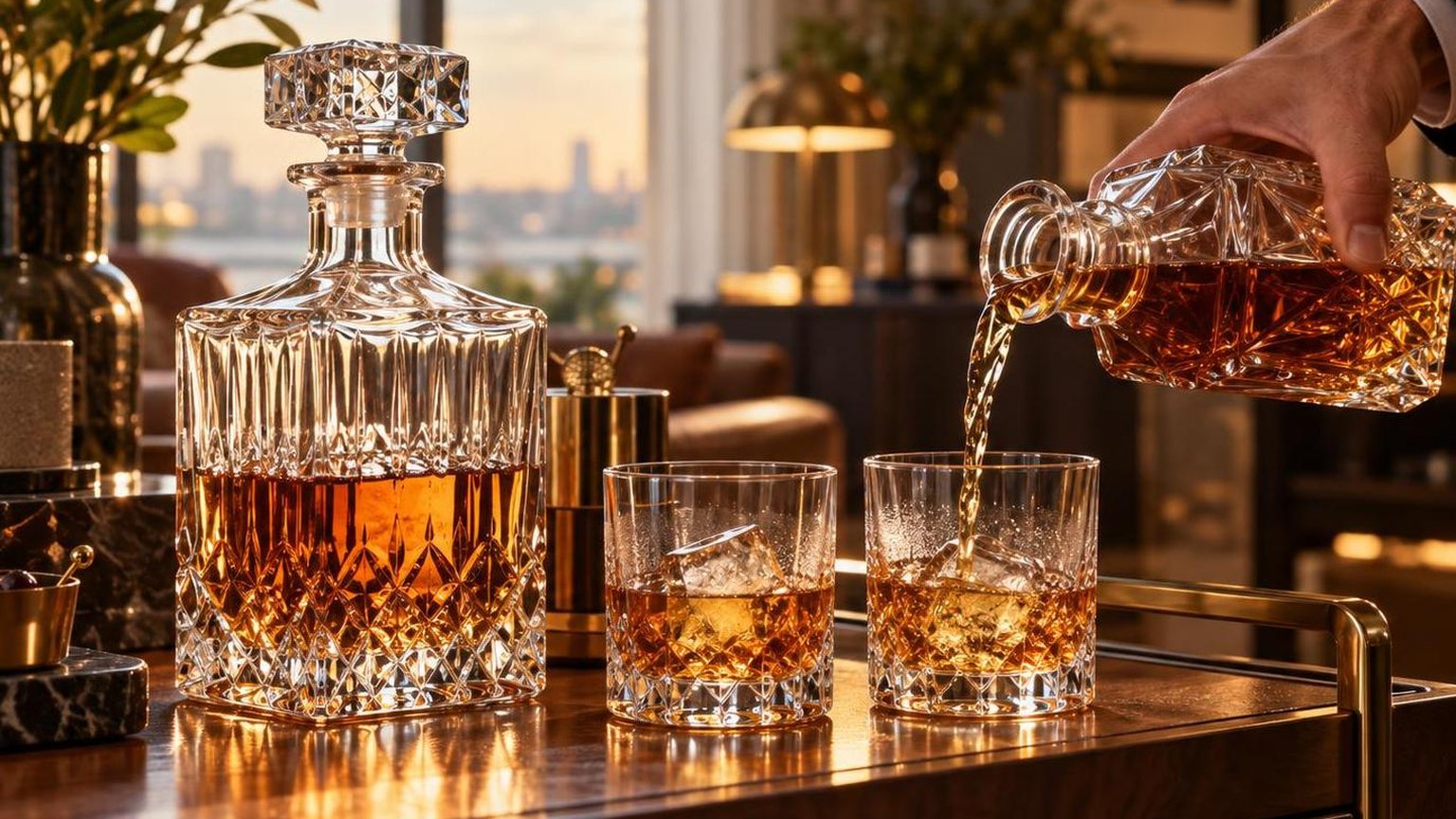
Signs Whiskey Has Gone Flat or Stale
Whiskey that has gone flat usually loses aromatic intensity and flavor definition rather than developing obvious spoilage.
In a decanter, a poor seal, repeated opening, light, and heat can change its character; appearance alone cannot establish freshness or safety.
The Aroma Becomes Muted or Unbalanced
Look for the disappearance of notes you previously recognized: citrus, vanilla, fresh fruit, floral aromas, or distinctive smoke.
A stale pour may smell less expressive, with alcohol or woody notes seeming more prominent because other aromas have faded.
That impression is not proof by itself. Glass shape, serving temperature, recent food, and nasal congestion affect perception.
Nor does a strong alcohol smell establish that the whiskey’s alcohol concentration has increased; your nose cannot measure proof.
The Palate Loses Definition
On tasting, formerly distinct flavors may seem blurred, thin, or less persistent. The finish can feel shorter, and bitterness or a drying oak character may dominate. These are quality judgments, not diagnostic tests for contamination.
Compare against your memory cautiously. Different batches, added water, and different glasses can produce similar changes. Whiskey does not continue barrel maturation in a glass decanter, so declining balance is not evidence of beneficial aging.
Check It Against a Fresh Reference
If available, use a recently opened bottle of the same expression. Pour into identical, clean glasses, keep both samples at the same room temperature, and avoid adding water initially.
The quantities below are a practical tasting setup, not a laboratory standard.
| Sample | Pour | Purpose |
| Decanted whiskey | 15 mL | Assess suspected aroma and flavor loss. |
| Recently opened reference | 15 mL | Check the expression’s expected character. |
Smell each sample before tasting. If the decanted whiskey consistently seems duller, check the stopper and transfer the remainder to a clean, tightly capped glass bottle. This limits further exposure; it cannot restore lost aromas.
Separate Staleness From Safety Concerns
Cloudiness alone does not establish spoilage. Non-chill-filtered whiskey can develop haze when cooled or diluted because some naturally occurring compounds become less soluble.
Unexpected particles, visible growth, or a foreign chemical odor warrant a different response: do not taste it to investigate.
Scotch whisky must contain at least 40% alcohol by volume under the Scotch Whisky Regulations 2009.
That alcoholic strength makes ordinary microbial spoilage unlikely, but it does not protect against dirty containers, chemical contamination, or substantial accidental dilution.
Lead is especially important: you cannot reliably detect it by smell, taste, or clarity. The FDA identifies lead crystal as a potential source of lead exposure.
If your decanter contains lead crystal, stop using it for storage; a normal-tasting pour does not demonstrate safety.
Sources: Scotch Whisky Regulations 2009, regulation 3; U.S. Food and Drug Administration, “Lead in Food and Foodwares.”.
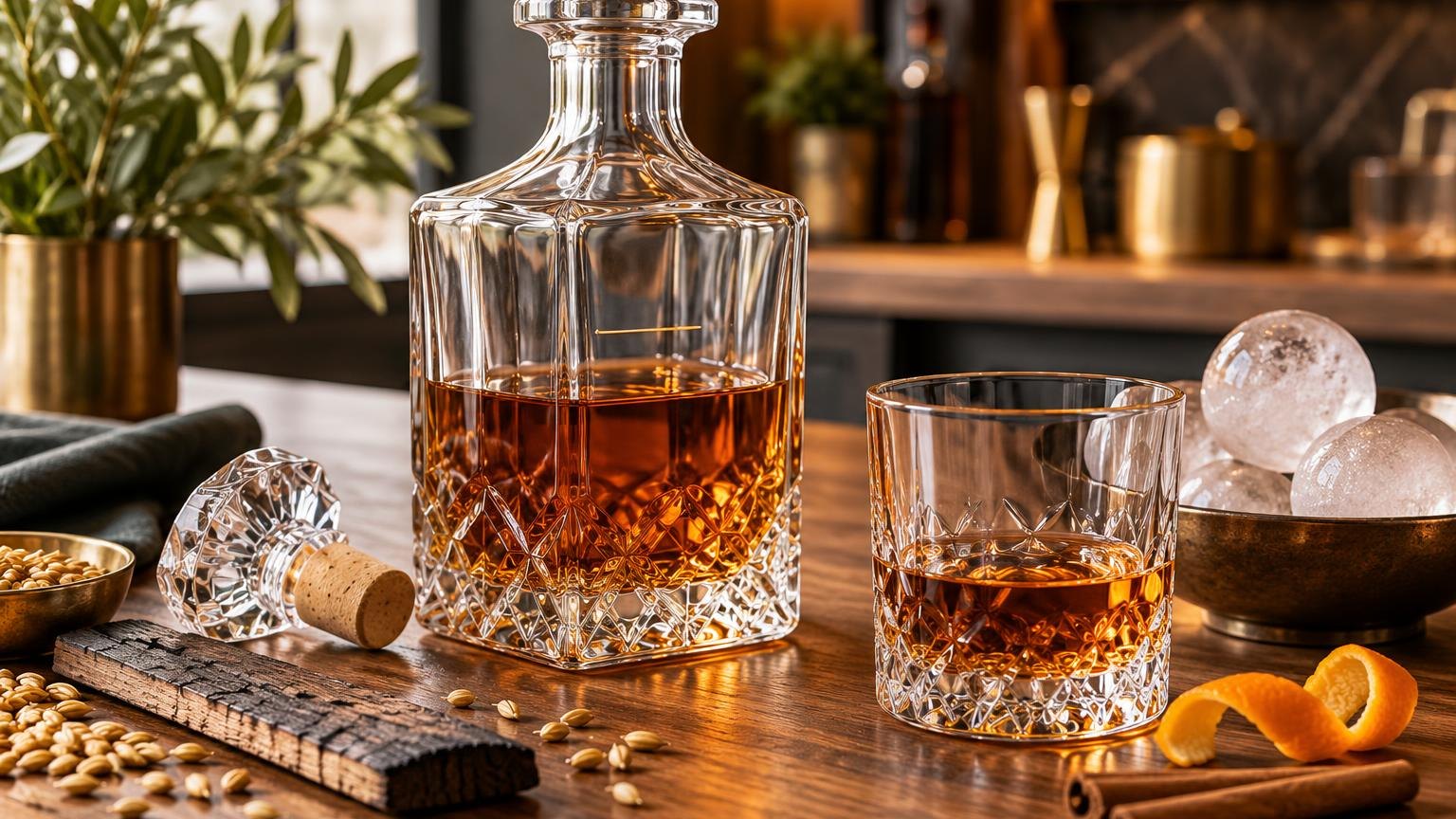
Questions People Ask Most
How long does whiskey last in a decanter?
Whiskey has no fixed expiration date in a decanter; the seal, glass composition, light exposure, and remaining volume determine how well it keeps.
For routine serving, use a conservative rotation of 1–3 months in a tightly sealed, lead-free decanter, treating that as a quality-management target rather than a proven shelf-life limit.
Does a decanter stopper preserve whiskey as well as a bottle cap?
A well-fitted stopper can limit evaporation and air exchange, but a decorative stopper does not necessarily create an airtight seal.
If the stopper sits loosely or the liquid level drops without pouring, return the whiskey to its original, tightly closed bottle.
Does whiskey deteriorate faster in a nearly empty decanter?
A nearly empty decanter contains more air relative to the whiskey, which can contribute to aroma and flavor changes, especially with repeated opening.
For example, a 750 mL decanter holding 150 mL of whiskey has roughly 600 mL of headspace; transfer that remainder to a smaller, tightly sealed bottle.
Where should you store a whiskey decanter?
Keep it upright in a dark cupboard at a stable room temperature, away from windows, radiators, and stovetops.
Direct sunlight and heat can accelerate quality changes and evaporation, so a sunny bar cart is better for temporary presentation than long-term storage.
Is lead crystal safe for storing whiskey?
Do not store whiskey in lead-crystal decanters. The FDA’s guidance on lead in foodware warns that lead can leach into beverages from lead crystal; use a decanter explicitly documented as lead-free,.
And keep whiskey in its original bottle if the material is unknown.
Can decanted whiskey spoil or become unsafe to drink?
Standard whiskey bottled at 40% ABV is not a favorable environment for most foodborne pathogens, so ordinary storage concerns center on flavor loss rather than microbial spoilage.
However, contamination or lead exposure can make it unsafe, and normal taste or smell cannot rule out lead; discard whiskey with visible growth or known chemical contamination.
Should you wash a decanter before adding fresh whiskey?
Wash a new decanter and clean it between batches, especially when changing whiskies or removing residue.
Use warm water and a little unscented dish detergent, rinse thoroughly, and let it drain and dry completely so detergent and retained water do not alter the next fill.
Does adding water change how long whiskey keeps in a decanter?
Water lowers the alcohol concentration and changes the whiskey’s aroma balance; adding equal volumes of water and 40% ABV whiskey produces approximately 20% ABV.
Storage expectations for full-strength whiskey no longer apply reliably after substantial dilution, so add water or ice in the serving glass rather than the storage decanter.
Related Guides
- 15 Best Corkscrew Products That Will Simplify Your Life
- Top 15 Best Wine Openers of 2026 (Tested & Ranked)
- 10 Best Wine Stopper in 2026 – Reviews and Buying Guide
- The Top 15 Best Cigar Cutter Products You Need Right Now
- The 15 Best Cigar Humidor of the Year
- All Accessories Guides
- Whisky.com — Storage of Whisky (n.d.)
- Scotch Whisky Association — FAQs (n.d.)
- Jack Daniel’s — FAQs (n.d.)
- Glencairn Crystal — The Glencairn Whisky Glass (n.d.)
- Encyclopaedia Britannica — Whiskey (n.d.)
- U.S. Food and Drug Administration — Lead in Food and Foodwares (n.d.)
- Agency for Toxic Substances and Disease Registry — Toxicological Profile for Lead (2020)
- National Toxicology Program — Health Effects of Low-Level Lead (2012)
- National Center for Biotechnology Information, PubChem — Ethanol (n.d.)
- National Institute of Standards and Technology — Ethanol: Phase Change Data (n.d.)