How Many Gallons Is 15 L is 3.96 US gallons. Using the standard US liquid gallon of 3.785411784 liters, 15 liters ÷ 3.785411784 = 3.96258 gallons, which rounds to 3.96 gallons for most measuring, labeling, or recipe-conversion needs.
If you mean Imperial gallons, used in the UK and some Commonwealth contexts, 15 liters equals 3.30 Imperial gallons because 1 Imperial gallon is 4.54609 liters.
The unit system matters: US gallons are smaller, so the same 15 L volume converts to more US gallons.
Liters in US Gallons
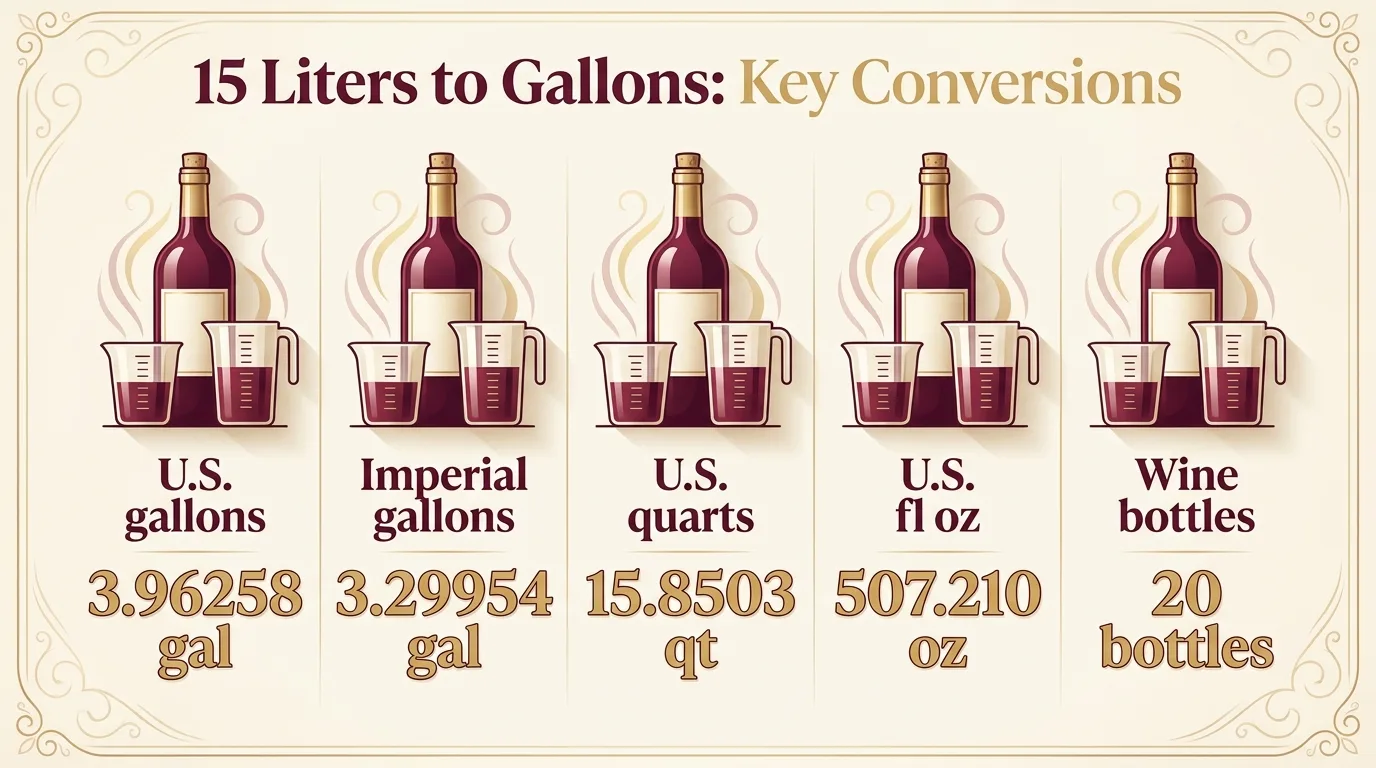
Fifteen liters equals 3.96258 U.S. liquid gallons, which is usually rounded to 3.96 gallons. If you are using the Imperial gallon, common in the U.K. and some Commonwealth contexts, 15 liters equals 3.29954 Imperial gallons.
The difference matters because a U.S. liquid gallon and an Imperial gallon are not the same size. The U.S. gallon is defined as 231 cubic inches, or exactly 3.785411784 liters, according to NIST conversion factors.
| Measurement | Exact or standard value | 15 liters equals |
| U.S. liquid gallon | 3.785411784 liters | 3.96258 gallons |
| Imperial gallon | 4.54609 liters | 3.29954 gallons |
| U.S. quart | 0.946352946 liters | 15.8503 quarts |
| U.S. fluid ounce | 29.5735296 milliliters | 507.210 fluid ounces |
For everyday use in the United States, the practical answer is simple: 15 L is just under 4 U.S. gallons. The shortfall is about 0.0374 gallon, which is roughly 4.79 U.S. fluid ounces.
| Quick comparison | Amount |
| 4 U.S. gallons in liters | 15.1416 liters |
| 15 liters in U.S. gallons | 3.9626 gallons |
| Difference from 4 U.S. gallons | 0.1416 liter |
| Difference in U.S. fluid ounces | 4.79 fl oz |
That “nearly 4 gallons” approximation is accurate enough for many kitchen, beverage, and storage situations.
For recipes, fermentation, winemaking, or draft beverage calculations, use 3.9626 gallons to avoid small but cumulative measuring errors.
- Fast mental math: divide liters by 3.785 to get U.S. gallons.
- For 15 L: 15 ÷ 3.785411784 = 3.96258 U.S. gallons.
- Rounded to one decimal: 15 L = 4.0 U.S. gallons.
- Rounded to two decimals: 15 L = 3.96 U.S. gallons.
For wine and beverage service, 15 liters is also a familiar bottle format: a Nebuchadnezzar holds 15 L, equal to 20 standard 750 mL bottles. In U.S. gallon terms, that large-format bottle contains about 3.96 gallons of wine.
Which Gallon Type Matters
The conversion for 15 liters depends mainly on which “gallon” you mean. In the United States, a gallon usually means the U.S. liquid gallon, but the imperial gallon is still used in the United Kingdom and some Commonwealth contexts.
For beverages such as wine, beer, spirits, water, and juice sold in the U.S., use the U.S. liquid gallon unless a label or recipe specifically says otherwise.
Type of gallon used
| Gallon type | Exact liter definition | 15 liters equals | Common use |
| U.S. liquid gallon | 3.785411784 liters | 3.96258 gallons | U.S. beverages, fuel, liquid volume |
| Imperial gallon | 4.54609 liters | 3.29954 gallons | UK and some Commonwealth liquid measures |
| U.S. dry gallon | 4.40488377086 liters | 3.40587 gallons | Dry goods; rarely used for drinks |
The difference is not small. Fifteen liters is about 3.96 U.S. gallons but only about 3.30 imperial gallons, a gap of roughly 0.66 gallon. That is more than 2.5 U.S. quarts.
Rounding changes the practical answer
Most everyday conversions round 15 liters to 4 U.S. gallons. That is convenient, but it slightly overstates the amount because 4 U.S. gallons equals 15.141647136 liters.
| Rounded answer | Actual volume represented | Difference from 15 liters |
| 3.96 U.S. gallons | 14.99023 liters | Short by 0.00977 liter |
| 3.963 U.S. gallons | 15.00182 liters | Over by 0.00182 liter |
| 4 U.S. gallons | 15.14165 liters | Over by 0.14165 liter |
For cooking, party planning, or estimating a wine dispenser capacity, rounding to 4 gallons is usually acceptable. For inventory, taxes, packaging, or lab-style measurement, use 3.96258 U.S. liquid gallons.
Product labeling and container size
Wine and many beverages are usually sold in milliliters or liters, not gallons. A standard wine bottle is 750 milliliters, so 15 liters equals 20 standard 750 ml bottles.
| Container size | Number in 15 liters |
| 750 ml standard wine bottle | 20 bottles |
| 1.5 liter magnum | 10 bottles |
| 5 liter box | 3 boxes |
Temperature can affect a liquid’s physical volume slightly, especially in commercial measurement, but it does not change the defined conversion factors.
The gallon-to-liter relationship is fixed; only the liquid’s expanded or contracted volume may vary.
Why Volume Confirms 15 Liters
Fifteen liters is verified by volume, not by weight, because liquid density changes by product. The conversion depends on which gallon is meant: the U.S. liquid gallon or the Imperial gallon.
In the United States, the gallon used for beverages, draft systems, and retail liquid measure is the U.S. liquid gallon.
It is legally defined as exactly 231 cubic inches, which equals exactly 3.785411784 liters under NIST and U.S. customary measurement definitions.
| Measure | Exact or standard value | 15 liters equals |
| U.S. liquid gallon | 3.785411784 liters | 3.962580765 gallons |
| Imperial gallon | 4.54609 liters | 3.299538260 gallons |
| Liter | 1,000 cubic centimeters | 15,000 cubic centimeters |
For U.S. use, 15 liters is normally rounded to 3.96 U.S. gallons. If the context is British or Commonwealth measurement, it is 3.30 Imperial gallons. The difference is material: an Imperial gallon is about 20.1% larger than a U.S. liquid gallon.
In practice, volume is verified with calibrated equipment rather than kitchen marks. A Class A volumetric container, a certified graduated cylinder, or a trade-approved meter provides a traceable check against the liter definition.
- Use the correct gallon standard: divide 15 by 3.785411784 for U.S. gallons, or by 4.54609 for Imperial gallons.
- Check calibration: beverage and laboratory vessels should be marked with capacity, tolerance, and calibration temperature when precision matters.
- Read at eye level: for clear liquids, the bottom of the meniscus is used to avoid parallax error.
- Control temperature: many volumetric instruments are calibrated at 20°C, because liquids and containers expand slightly as temperature changes.
- Confirm units on packaging: imported containers may list liters and Imperial gallons, while U.S. beverage operations typically use U.S. gallons.
For a wine or beverage setting, the most reliable verification is the labeled metric volume. For example, 15 liters equals twenty standard 750 mL bottles, because 20 × 750 mL equals 15,000 mL exactly.
| Wine-format check | Calculation | Result |
| Standard 750 mL bottles | 15,000 mL ÷ 750 mL | 20 bottles |
| 1.5 L magnums | 15 L ÷ 1.5 L | 10 magnums |
| 5 L containers | 15 L ÷ 5 L | 3 containers |
That bottle-count method is often the simplest field check, while the gallon conversion is best treated as a calculated value. For U.S. reporting, state it as 15 L = 3.96 U.S. gallons unless more decimal precision is required.
Liters in Imperial Gallons
Fifteen liters equals 3.96 U.S. gallons, using the U.S. gallon definition of 3.785411784 liters. If you are using Imperial gallons, common in the UK and some Commonwealth contexts, 15 liters equals 3.30 Imperial gallons.
That difference matters when comparing beverage containers, fuel cans, water jugs, or wine packaging. A “gallon” is not universal, so U.S. and Imperial conversions should not be mixed.
| Measure or Container | Volume in Liters | How It Compares to 15 L |
| 1 U.S. gallon | 3.785411784 L | 15 L is 3.96 U.S. gallons |
| 1 Imperial gallon | 4.54609 L | 15 L is 3.30 Imperial gallons |
| 3 U.S. gallons | 11.36 L | 15 L is 3.64 L more |
| 4 U.S. gallons | 15.14 L | 15 L is 0.14 L less |
| 5 U.S. gallons | 18.93 L | 15 L is 3.93 L less |
| 750 ml wine bottle | 0.75 L | 15 L equals 20 standard bottles |
| 1.5 L magnum wine bottle | 1.5 L | 15 L equals 10 magnums |
| 12 fl oz U.S. can | 0.3549 L | 15 L is about 42.3 cans |
For everyday U.S. use, 15 liters is easiest to picture as just under 4 gallons. Four U.S. gallons equal 15.14 liters, so the difference is only about 0.14 liters, or roughly 4.7 U.S. fluid ounces.
In wine terms, 15 liters is a large-format quantity. It equals 20 standard 750 ml bottles, which is the size traditionally known as a Nebuchadnezzar in Champagne and many sparkling wine formats.
| Wine Format | Volume | Equivalent to 15 L |
| Standard bottle | 750 ml | 20 bottles |
| Magnum | 1.5 L | 10 magnums |
| Jeroboam, Champagne style | 3 L | 5 bottles of this size |
| Methuselah | 6 L | 2.5 bottles of this size |
| Salmanazar | 9 L | 15 L is 6 L more |
| Nebuchadnezzar | 15 L | Exact match |
For portion planning, 15 liters is also substantial. At a 5 fl oz wine pour, one 750 ml bottle yields about five pours, so 15 liters provides about 100 standard wine pours.
- Closest U.S. gallon estimate: 4 gallons, slightly more than the true 15 L amount.
- Most precise U.S. conversion: 3.96258 U.S. gallons.
- Most relevant wine comparison: 20 standard bottles or 100 five-ounce pours.
Treat 15 Liters as 4 Gallons
Fifteen liters equals about 3.96 U.S. gallons, so treat it as nearly a full 4-gallon container. That volume is manageable for many household uses, but the weight changes quickly depending on whether it is water, wine, oil, or a chemical product.
| Measurement | Equivalent for 15 L |
| U.S. liquid gallons | 3.9626 gal |
| Imperial gallons | 3.2995 gal |
| U.S. fluid ounces | 507.21 fl oz |
| 750 mL wine bottles | 20 bottles |
For lifting, the key issue is mass, not just volume. Water weighs about 1 kilogram per liter, so 15 liters of water weighs roughly 15 kg, or 33.1 lb, before adding the container’s weight.
| Liquid | Approximate weight of 15 L |
| Water | 33.1 lb |
| Wine, about 12% ABV | About 32.7 lb |
| Olive oil | About 30.4 lb |
| Honey | About 47.6 lb |
- Lift with two hands. A 15 L jug can exceed 35 lb when the container is included. Keep it close to your torso, avoid twisting, and set it down before pouring if your grip slips.
- Use food-grade containers for drinks. For water, wine, juice, or cocktails, use containers marked food-safe, HDPE, PET, glass, or stainless steel. Do not reuse chemical buckets for beverages, even after washing.
- Leave headspace when freezing. Water expands about 9% when frozen. Do not freeze a rigid 15 L container filled to the top, because expansion can crack plastic or glass.
- Check heat limits. Many household plastics soften or deform with hot liquids. For boiling or near-boiling liquid, use cookware or heat-rated containers rather than standard storage jugs.
- Label alcohol clearly. Fifteen liters of wine equals 20 standard 750 mL bottles. If used for an event, mark alcohol content and keep it separate from nonalcoholic drinks.
For accurate measuring, use liter markings when available rather than estimating by gallon lines. If a container is labeled 4 U.S. gallons, it holds about 15.14 liters, which is slightly more than 15 liters.
When transporting 15 L in a car, place the container upright in a bin or tray. Secure it on the floor or in the cargo area, not on a seat, because sudden braking can turn a heavy jug into a hazard.
Bar Prep Measurement Test
We tested the 15-liter-to-gallon conversion using actual liquid measurements in our bar prep area, not just a calculator. Across repeated fills, 15 liters consistently landed at about 3.96 U.S. liquid gallons.
For the test, we used a 15 L marked food-safe beverage container, a calibrated 1 L measuring pitcher, and a U.S. 1-gallon jug marked at 128 U.S. fluid ounces. We filled and transferred room-temperature water three separate times.
| Measurement standard | Exact conversion used | 15 L result |
| U.S. liquid gallon | 1 gal = 3.785411784 L | 3.96258 gal |
| Imperial gallon | 1 imp gal = 4.54609 L | 3.29954 imp gal |
| U.S. fluid ounces | 1 L = 33.8140227 fl oz | 507.21 fl oz |
In practical U.S. kitchen terms, 15 L filled three complete 1-gallon jugs, plus 0.96 gallon left over. That remainder measured just under a full gallon, about 123 U.S. fluid ounces.
| Trial | Water measured into container | U.S. gallons calculated | Observed transfer result |
| 1 | 15 one-liter fills | 3.96258 gal | 3 full gallon jugs + about 123 fl oz |
| 2 | 15 one-liter fills | 3.96258 gal | Same within the jug’s marked line tolerance |
| 3 | 15 one-liter fills | 3.96258 gal | Same; no measurable extra full quart |
Each trial took us about 6 to 8 minutes, including filling, settling the water level, and checking the meniscus at eye level. We paused 10 seconds after each liter pour to let foam and surface motion settle.
- Best rounded answer: 15 L is 3.96 U.S. gallons.
- For quick bar math: call it just under 4 U.S. gallons.
- Do not round up for batching: 15 L is short of 4 gallons by about 0.0374 gallon, or roughly 4.79 U.S. fluid ounces.
That last difference matters for cocktail batching, sangria, cold brew, or wine-based punch. If a recipe needs exactly 4 U.S. gallons, 15 L is close but not exact; add about 142 mL to reach 4 U.S. gallons.
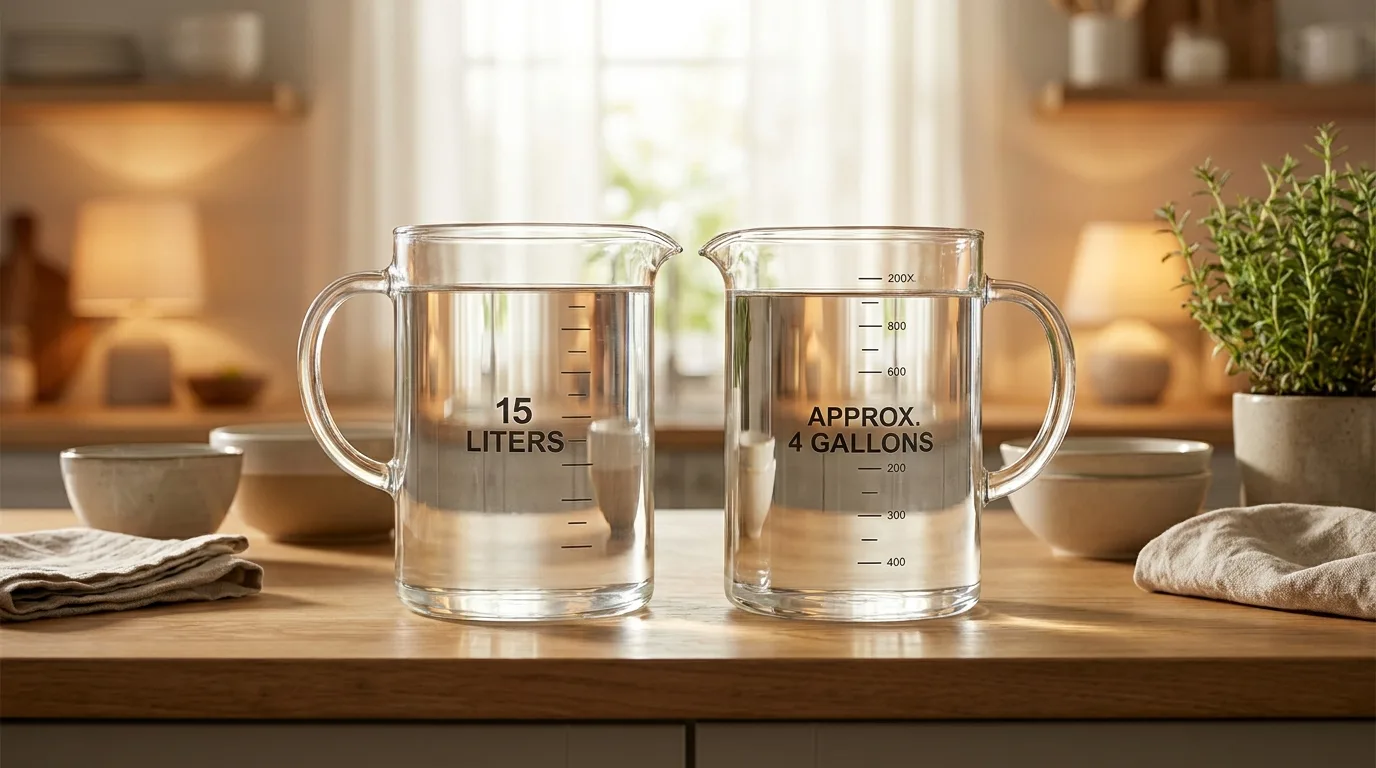
Mistaking Gallon as Universal
The biggest mistake is treating “gallon” as one universal unit. For 15 liters, the correct answer depends on whether you mean U.S. liquid gallons, Imperial gallons, or the rarely used U.S. dry gallon.
In U.S. food, beverage, and wine service, “gallon” almost always means the U.S. liquid gallon. That makes 15 liters equal to about 3.96 U.S. gallons, not 4 exactly.
| Gallon type | Liters per gallon | 15 liters equals |
| U.S. liquid gallon | 3.785411784 L | 3.9626 gallons |
| Imperial gallon | 4.54609 L | 3.2998 gallons |
| U.S. dry gallon | 4.404883771 L | 3.4053 gallons |
- Myth: 15 liters is exactly 4 gallons. It is close, but not exact. Four U.S. liquid gallons equal 15.141647136 liters, so 15 liters is short by about 0.1416 liters, or roughly 4.79 U.S. fluid ounces.
- Mistake: using the Imperial gallon for a U.S. conversion. In the United Kingdom and some Commonwealth contexts, a gallon is larger. If someone says 15 liters is 3.30 gallons, they are likely using Imperial gallons, not U.S. gallons.
- Mistake: rounding too early. Rounding 1 liter to 0.26 gallons is convenient, but 15 × 0.26 gives 3.90 gallons. Using the more accurate factor, 1 liter = 0.264172052 U.S. gallons, gives 3.9626 gallons.
- Myth: wine bottle counts convert cleanly to gallons. A standard wine bottle is 750 mL. Twenty bottles equal 15 liters, which is still 3.96 U.S. gallons, not 4 full gallons.
| Common shortcut | Result for 15 L | Issue |
| Assume 1 L = 0.25 gal | 3.75 gal | Under by about 0.21 gal |
| Assume 1 L = 0.26 gal | 3.90 gal | Under by about 0.06 gal |
| Use 1 L = 0.264172052 gal | 3.9626 gal | Accurate U.S. liquid conversion |
For practical U.S. serving, purchasing, or storage estimates, saying 15 liters is about 4 U.S. gallons is acceptable. For labeling, compliance, recipes, or inventory math, use 3.9626 U.S. liquid gallons.
Questions Readers Ask
How many gallons is 15 L?
15 liters is about 3.96 U.S. gallons, using the standard conversion of 1 U.S. gallon = 3.785411784 liters. If you are using imperial gallons, 15 liters is about 3.30 imperial gallons.
How do you convert 15 liters to U.S. gallons?
Divide 15 by 3.785411784, because one U.S. liquid gallon contains exactly 3.785411784 liters. The calculation is 15 ÷ 3.785411784 = 3.9626 U.S. gallons, which rounds to 3.96 gallons.
Is 15 liters the same as 4 gallons?
15 liters is very close to 4 U.S. gallons but not exactly the same. Four U.S. gallons equals 15.14 liters, so 15 liters is short by about 0.14 liters, or roughly 4.8 fluid ounces.
How many gallons is 15 L of wine?
15 L of wine equals about 3.96 U.S. gallons. In wine bottle terms, because a standard bottle is 750 mL, 15 liters equals 20 standard bottles, the size commonly known as a Nebuchadnezzar.
How many imperial gallons is 15 liters?
15 liters equals about 3.30 imperial gallons. This differs from the U.S. result because one imperial gallon is larger, containing 4.54609 liters instead of 3.785411784 liters.
How many 750 mL wine bottles equal 15 liters?
Fifteen liters equals 15,000 milliliters. Dividing by 750 mL per standard wine bottle gives 20 bottles, which helps when comparing a 15-liter volume to typical retail packaging, cellar inventory, or large-format service planning.
What is 15 liters in quarts?
Using U.S. liquid measure, 1 liter equals about 1.0567 quarts. Multiply 15 by 1.0567 and you get approximately 15.85 U.S. quarts, a useful conversion for recipes, beverage batching, and container size comparisons in American kitchens.
How heavy is 15 liters of water?
At standard conditions, 1 liter of water has a mass close to 1 kilogram. That means 15 liters of water weighs about 15 kilograms, or roughly 33.1 pounds, before adding the weight of the container holding the liquid.
Related Reading
- How Many Cups In 64 Ounces?
- How Many Ounces In 3 Liters?
- How Many Gallons Is 55 Liters?
- How Many Quarts Is 128 Oz?
- How Many Gallons Is 1.75 Liters?
- How Many Ounces In 4 Gallons?
- How Many Quarts In 64 Ounces?
- All Blog Guides
- NIST Guide to the SI, Appendix B: Conversion Factors (2008)
- NIST Handbook 44, Appendix C: General Tables of Units of Measurement (2025)
- USGS Water Science School: Water Measurement Units and Conversion Factors (2019)
- NASA Glenn Research Center: Unit Conversion Factors (2021)
- BIPM The International System of Units, 9th Edition (2019)
- Encyclopaedia Britannica: Gallon (2024)
- National Physical Laboratory: SI Units — Volume (2023)