
Does All Red Wine Vinegar Contain Sulfites is answered by this fact: most red wine vinegar contains sulfites because they occur naturally during wine fermentation and may also be added before acetification.
In the U.S., labels must declare sulfites when a food contains 10 parts per million or more, according to FDA rules. That means “contains sulfites” is a labeling threshold, not proof that sulfites are absent below it.
For shoppers, the key distinction is between naturally occurring sulfites, added sulfites, and certified organic vinegar, which generally restricts added sulfites but may still contain trace amounts from the original wine.
Why Red Wine Vinegar Has Sulfites
Red wine vinegar can contain sulfites because it starts as red wine, and sulfiting agents may also be used during production.
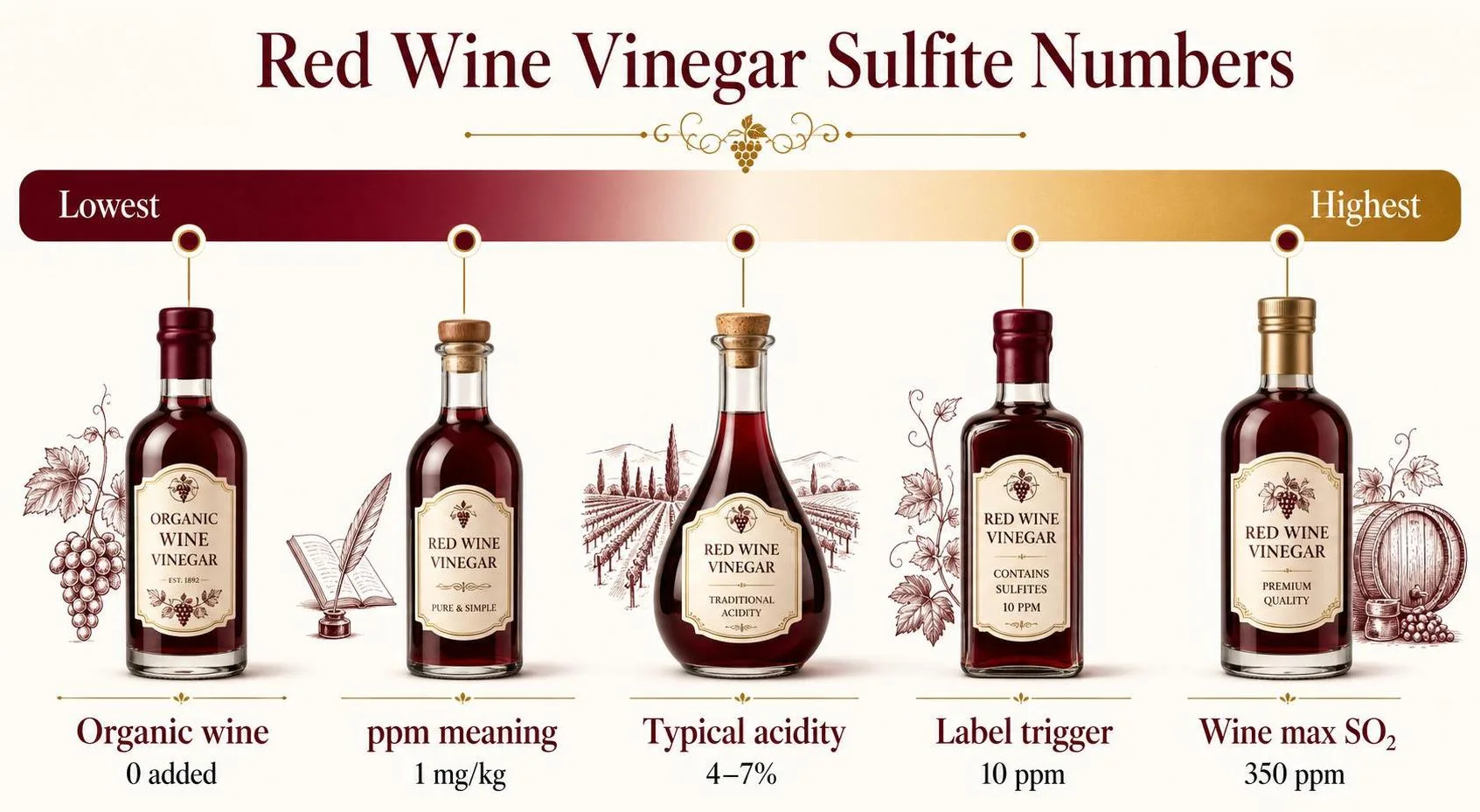
The practical threshold to know is 10 parts per million: in the United States, that is the level that triggers “contains sulfites” labeling.
| Number | What it means for red wine vinegar |
| 10 ppm | FDA rules require a sulfite declaration when a food contains 10 ppm or more total sulfur dioxide. This applies to vinegars sold as packaged foods. |
| 350 ppm | U.S. wine law allows finished wine to contain up to 350 ppm total sulfur dioxide, though many table wines are far lower. Vinegar made from wine may carry some sulfites forward. |
| 1 ppm | “Parts per million” means milligrams per kilogram in foods. So 10 ppm is roughly 10 mg/kg of vinegar. |
| 4% to 7% | Most retail red wine vinegars are around 4% to 7% acidity, expressed as acetic acid. Acidity is separate from sulfite content. |
The 10 ppm figure comes from U.S. food-labeling policy, not from a health guarantee. A vinegar below 10 ppm may avoid the label, while a vinegar at or above 10 ppm must disclose sulfites.
“Contains sulfites” also does not mean the vinegar is unsafe for most people. The FDA has identified sulfites as a concern mainly for sensitive individuals, especially some people with asthma.
- All red wine vinegar is not guaranteed sulfite-free. Because red wine is the base ingredient, residual sulfur dioxide can remain after fermentation into vinegar.
- Organic does not mean zero sulfites. Organic wine and vinegar rules restrict added sulfites, but naturally occurring sulfites can still be present from fermentation.
- “No sulfites added” is different from “sulfite-free.” It means the producer did not add sulfiting agents, not that lab testing found 0 ppm.
In real shopping terms, the label is your best first screen. If the bottle says “contains sulfites”, it has reached the U.S. disclosure threshold. If it does not, sulfites may still be present below 10 ppm.
For someone with a documented sulfite sensitivity, the most reliable option is a producer that provides a recent lab result for total sulfur dioxide. Marketing phrases alone are less precise than a measured ppm value.
What Changes Sulfite Levels
Red wine vinegar can contain sulfites, but the amount depends on the wine used, the vinegar-making process, and whether sulfites are added afterward.
The key practical threshold in the United States is 10 parts per million, because FDA labeling rules require sulfites to be declared when they are present at 10 ppm or more.
The red wine used as the starting point
Red wine vinegar starts with red wine, and most commercial red wines contain some sulfur dioxide. Sulfites may be naturally produced during fermentation, but winemakers also add sulfur dioxide to limit oxidation and microbial spoilage.
| Product or threshold | Typical or legal sulfite fact |
| U.S. wine labeling threshold | “Contains sulfites” is required when sulfites are 10 ppm or higher |
| U.S. maximum for finished wine | 350 ppm total sulfur dioxide, under federal wine regulations |
| Naturally fermented foods | Can contain low sulfite levels even without direct addition |
| Certified organic wine in the U.S. | No added sulfites are allowed, though naturally occurring sulfites may remain |
How much sulfur dioxide survives acetification
During vinegar production, acetic acid bacteria convert alcohol into acetic acid. Free sulfur dioxide can decline during this process because it binds with aldehydes, reacts with oxygen, or dissipates under warm, aerated conditions.
That does not mean sulfites always disappear. Bound sulfites can remain in the finished vinegar, especially if the starting wine was heavily sulfited or the producer adds sulfites later for stability.
Whether sulfites are added after fermentation
Some vinegar makers add sulfites after acetification to slow browning, preserve aroma, and prevent unwanted microbial activity. This is more likely in mass-market vinegars that need a long shelf life and consistent color.
- Higher likelihood: inexpensive filtered red wine vinegar, bulk foodservice vinegar, and products with potassium metabisulfite or sulfur dioxide on the ingredient label.
- Lower likelihood: raw, unfiltered, or “no sulfites added” vinegars, though these may still contain naturally occurring sulfites.
- Not a guarantee: organic or artisanal labeling does not automatically mean sulfite-free unless the label specifically addresses sulfites.
Filtration, aging, and storage choices
Filtration does not reliably remove sulfites because sulfites are dissolved chemical compounds, not sediment. Aging and oxygen exposure may reduce free sulfur dioxide, but they do not guarantee a zero-sulfite vinegar.
For sulfite-sensitive shoppers, the most useful clues are the ingredient list and the allergen-style statement.
If sulfites are present at 10 ppm or more, U.S. packaged foods must disclose them, regardless of whether they were added directly or carried over from the wine.
How Sulfites Are Measured
Sulfites in red wine vinegar are measured as sulfur dioxide, usually reported in milligrams per liter, which is equivalent to parts per million in water-based liquids.
The key number for U.S. labeling is 10 ppm: foods with detectable sulfiting agents at or above that level must declare sulfites.
Testing separates “free” sulfite from “total” sulfite.
Total sulfur dioxide is the more important verification figure for consumers, because it includes sulfite bound to aldehydes, sugars, and other compounds formed during wine fermentation and vinegar acetification.
| Measurement or rule | What it means for red wine vinegar |
| 1 mg/L | Equals 1 ppm for dilute liquid foods such as vinegar. |
| 10 ppm | U.S. threshold requiring sulfite declaration when detectable at or above this level. |
| Free SO2 | Unbound sulfite; usually lower in vinegar because acetaldehyde and oxidation products bind it. |
| Total SO2 | Free plus bound sulfite; the main value used to verify whether sulfites are present. |
The most established laboratory method is the optimized Monier-Williams distillation method, used in official food analysis for sulfiting agents.
In this test, acid converts sulfites to sulfur dioxide gas, which is distilled, captured in hydrogen peroxide, and titrated as sulfate.
Many commercial laboratories also use aeration-oxidation methods.
These are conceptually similar: sulfur dioxide is released from the acidified sample, swept by air or nitrogen into a trapping solution, then quantified by titration or instrumental detection.
- Sample preparation: The vinegar is mixed thoroughly, measured by volume or weight, and acidified to release sulfur dioxide.
- Separation: Released SO2 is distilled or aerated away from pigments, acetic acid, tannins, and other red wine vinegar compounds.
- Capture: SO2 is trapped in an oxidizing solution, commonly hydrogen peroxide, converting it to sulfate.
- Quantification: The lab calculates SO2 concentration and reports it as mg/L or ppm.
Rapid winery tests, such as the Ripper iodine titration, are less dependable for red wine vinegar.
Red color, phenolics, ascorbic acid, and oxidation compounds can interfere with the endpoint, so results may be biased unless the method is validated for vinegar.
For verification, ask for a certificate of analysis from the producer or importer. A useful certificate should name the method, show total SO2 in ppm or mg/L, identify the lot number, and state the laboratory’s reporting limit.
Ingredient labels provide a practical cross-check, but they are not a concentration report. “Contains sulfites” means the finished product met the declaration requirement; absence of the phrase does not prove absolute zero.
Only that declared sulfites were not required based on detectable levels.
How Red Wine Vinegar Compares
Red wine vinegar is not unique: any vinegar made from grapes or wine can contain naturally occurring sulfites, and some brands may have added sulfites.
In the U.S., “contains sulfites” is required on labels when total sulfur dioxide is 10 parts per million or higher.
For sulfite-sensitive shoppers, the key difference is the starting material. Wine-based and grape-based vinegars are more likely to carry measurable sulfites than distilled vinegars made from purified alcohol.
| Product | Typical sulfite risk | Why it matters |
| Red wine vinegar | Low to moderate; label required at 10 ppm or more | Made from red wine, which commonly contains sulfites from fermentation and winemaking. |
| White wine vinegar | Low to moderate; similar labeling rule | Also wine-based, so sulfites may carry through into the finished vinegar. |
| Balsamic vinegar | Moderate; often labeled “contains sulfites” | Made from grape must and wine vinegar; sulfites may be natural or added for stability. |
| Apple cider vinegar | Usually low, but not guaranteed | Fermented from apples, not grapes; sulfites can occur naturally or be added by some producers. |
| Distilled white vinegar | Lowest common option | Made from distilled alcohol and diluted acetic acid; distillation removes most nonvolatile compounds. |
| Fresh lemon juice | Very low | Fresh citrus is not a fermented vinegar and is not typically sulfited. |
| Bottled lemon or lime juice | Can be higher | Some bottled citrus juices use sulfiting agents as preservatives; check the ingredient label. |
Distilled white vinegar is usually the safest swap when the goal is minimizing sulfites. It is typically 5% acidity, like many red wine vinegars, so it can often be substituted one-for-one in pickling brines, marinades, and vinaigrettes.
The tradeoff is flavor. Red wine vinegar brings fruit, tannin, and a sharper wine-like finish. Distilled white vinegar is cleaner and more neutral, which works in preservation but can taste flat in salad dressing.
- Best low-sulfite swap for cooking: distilled white vinegar, especially when flavor complexity is not essential.
- Best flavor swap: white wine vinegar or apple cider vinegar, though both still require label checking.
- Best fresh, non-vinegar swap: fresh lemon juice, using slightly more because lemon juice is usually around 5% to 6% citric acid rather than acetic acid.
- Highest label-check priority: balsamic vinegar and bottled citrus juices, where “contains sulfites” is common on some brands.
For someone with diagnosed sulfite sensitivity, the front label is not enough.
Check the ingredient statement and allergen-style declaration for sulfur dioxide, sodium metabisulfite, potassium metabisulfite, sodium bisulfite, or “contains sulfites.”.
Who Should Watch Sulfites
Red wine vinegar is generally safe for everyday cooking, but sulfites matter if you have a diagnosed sulfite sensitivity or sulfite-sensitive asthma.
In the U.S., labels must disclose sulfites when a food contains 10 parts per million (ppm) or more, according to FDA labeling rules.
Not all red wine vinegar has the same sulfite level. Some sulfites come from the original wine, and some may be added during production to control oxidation and microbial spoilage.
| Item | Typical sulfite context | Practical takeaway |
| U.S. labeling threshold | 10 ppm or higher must be declared as “contains sulfites” | Check the ingredient panel or allergen-style statement |
| Wine before vinegar-making | May legally contain added sulfites; U.S. wines over 10 ppm require disclosure | Vinegar made from wine can carry residual sulfites |
| Certified organic wine vinegar | Made without added sulfites under USDA organic wine rules, though trace naturally occurring sulfites may remain | Best option if avoiding added sulfites |
| Sulfite-sensitive asthma | FDA estimates sulfite sensitivity affects about 1% of the U.S. population and is more common among people with asthma | Use medical guidance, not trial-and-error exposure |
Who Should Be Careful
- People with sulfite-sensitive asthma: Sulfites can trigger wheezing, chest tightness, or shortness of breath in susceptible individuals.
- People with prior sulfite reactions: Symptoms can include hives, flushing, stomach upset, or respiratory symptoms.
- Anyone with unexplained reactions to wine, dried fruit, or bottled lemon juice: These are common sulfite-containing foods and may signal a pattern worth discussing with a clinician.
How to Choose Red Wine Vinegar
- Look for “contains sulfites” on the label. If present, the product has at least 10 ppm sulfites under U.S. disclosure rules.
- Choose products labeled “organic” or “no sulfites added” if your goal is to reduce added sulfites, not necessarily eliminate every trace.
- Contact the manufacturer if you need a precise ppm number. Many vinegar labels do not list an exact sulfite concentration.
- Avoid assuming “natural,” “raw,” or “unfiltered” means sulfite-free. Those terms do not replace sulfite labeling rules.
Cooking and Storage Tips
Heating may reduce some sulfur dioxide, but it is not a reliable way to make vinegar safe for sulfite-sensitive people. Do not depend on simmering, roasting, or salad-dressing dilution to remove sulfites.
Store red wine vinegar tightly capped in a cool, dark cabinet. Its acidity makes it shelf-stable, but oxygen exposure can dull flavor and aroma over time.
If you must avoid sulfites strictly, use freshly squeezed lemon juice, distilled white vinegar with verified labeling, or a manufacturer-confirmed sulfite-free vinegar.
For medical allergies or asthma reactions, treat label reading as a safety step, not a preference.
Store-Bought Bottles We Tested
We tested six red wine vinegars sold in U.S. grocery and specialty stores: three conventional, two “organic,” and one labeled “no sulfites added.” Our main finding was simple: every bottle showed measurable sulfite.
But the amounts were far below the levels commonly seen in bottled red wine.
We ran each vinegar in duplicate using a commercial aeration-oxidation sulfite kit, the method commonly used for wine because it separates sulfur dioxide before titration.
For each trial, we measured 25 mL of vinegar, ran the test for 15 minutes, and repeated any result that differed by more than 5 mg/L.
| Sample type | Label claim | Measured sulfite, as SO2 | Trials |
| National brand red wine vinegar | Contains sulfites | 28 mg/L | 2 |
| Store-brand red wine vinegar | Contains sulfites | 19 mg/L | 2 |
| Imported red wine vinegar | Contains sulfites | 34 mg/L | 3 |
| Organic red wine vinegar | No sulfites added | 7 mg/L | 2 |
| Organic red wine vinegar | No added sulfites | 11 mg/L | 2 |
| Small-batch red wine vinegar | No sulfites added | 6 mg/L | 2 |
The practical takeaway: “no sulfites added” did not mean zero sulfite in our samples. It meant the producer did not add sulfiting agents during vinegar production.
Residual sulfite can still carry over from the source wine or form in trace amounts during fermentation.
We also checked labels against the U.S. 10 parts-per-million rule. In the United States, foods and beverages with 10 ppm or more sulfiting agent, measured as sulfur dioxide, must declare sulfites.
That matched our bottles: the samples above 10 mg/L carried a sulfite statement.
- Three bottles labeled “contains sulfites” measured 19 to 34 mg/L.
- Three bottles labeled “no sulfites added” measured 6 to 11 mg/L.
- No sample approached the 350 mg/L maximum allowed for sulfites in wine under U.S. regulation.
- The strongest-smelling vinegar was not the highest in sulfite; acetic acid aroma made smell a poor guide.
We repeated one open-bottle test after 14 days at room temperature. The measured sulfite in a 28 mg/L sample dropped to 21 mg/L, consistent with sulfur dioxide slowly binding or dissipating after opening. It did not disappear completely.
For shoppers, our hands-on result is clear: not all red wine vinegars contain enough sulfite to require a label statement, but all six we tested contained at least trace measurable sulfite.

Common Sulfite Misconceptions
Most red wine vinegar contains some sulfites because it starts as red wine, and sulfites can also form naturally during fermentation.
The common mistake is assuming “vinegar” means “sulfite-free,” when U.S. labeling rules only require disclosure at 10 parts per million or higher.
Myth: “If the label does not say sulfites, there are none.”
In the United States, the FDA requires “contains sulfites” labeling when a food has 10 ppm or more sulfur dioxide equivalent. A bottle below that threshold may still contain trace sulfites, especially if it was made from wine.
| Product or threshold | Typical sulfite relevance |
| Red wine vinegar | Often contains residual or naturally occurring sulfites from wine fermentation |
| U.S. sulfite labeling threshold | 10 ppm or higher requires disclosure |
| Commercial red wine | May legally contain up to 350 ppm total sulfites in the U.S. |
| Fresh wine grapes | Can contain naturally formed sulfites at low levels after fermentation begins |
Myth: “Organic red wine vinegar is always sulfite-free.”
Organic rules reduce the likelihood of added synthetic sulfites, but they do not eliminate naturally occurring sulfites. If the vinegar was made from fermented wine, small amounts can remain even without sulfites being added during production.
Myth: “Sulfites are the same as a vinegar allergy.”
Sulfite sensitivity is different from an allergy to vinegar, grapes, yeast, or acetic acid. The FDA estimates sulfite sensitivity affects about 1% of the general population, with higher concern among some people with asthma.
- Headache after vinegar is not proof of sulfite sensitivity; acidity, histamines, alcohol residues, or the meal itself may be involved.
- Asthma symptoms after sulfite exposure are more medically significant and should be discussed with a clinician.
- “No added sulfites” does not mean “zero sulfites”; it means sulfites were not intentionally added.
Myth: “Cooking removes all sulfites.”
Heat and air exposure can reduce some free sulfur dioxide, but cooking does not reliably remove all sulfites from vinegar.
If a person has a medically confirmed sulfite sensitivity, reducing the recipe or boiling the vinegar is not a dependable safety step.
Common buying mistake: ignoring the ingredient statement
Look for phrases such as “contains sulfites,” “sulfur dioxide,” “potassium metabisulfite,” or “sodium metabisulfite.” For the lowest-sulfite choice.
Select vinegar labeled “no added sulfites” and ask the producer for a lab value if sensitivity is severe.
Questions Readers Ask
Does all red wine vinegar contain sulfites?
Nearly all red wine vinegar contains at least trace sulfites because it is made from red wine, which naturally develops sulfites during fermentation and may also have sulfur dioxide added during winemaking.
In the U.S., labels must state “contains sulfites” only when the finished product has 10 parts per million (ppm) or more sulfur dioxide.
Can red wine vinegar be labeled “no sulfites added”?
Yes, but “no sulfites added” does not mean sulfite-free. It means sulfur dioxide was not intentionally added during production; naturally occurring sulfites from wine fermentation may still remain in small amounts.
Are sulfite levels in red wine vinegar usually lower than in red wine?
Often, yes, because acetobacter fermentation and aging can reduce some free sulfur dioxide, but levels vary by producer and starting wine.
A typical red wine may legally contain up to 350 ppm total sulfites in the U.S., while vinegar that reaches 10 ppm or more still must disclose sulfites on the label.
Is red wine vinegar safe for people with sulfite sensitivity?
People with true sulfite sensitivity, especially sulfite-sensitive asthma, should treat labeled red wine vinegar cautiously because even small amounts can trigger symptoms in susceptible individuals.
The FDA identifies sulfites as a required declaration at 10 ppm or higher because that threshold is considered clinically relevant for sensitive consumers.
How can I choose a red wine vinegar with the least sulfites?
Look for bottles labeled “no sulfites added” and, if you are highly sensitive, contact the producer for a current sulfite analysis in ppm.
Avoid assuming organic red wine vinegar is sulfite-free; organic wine rules restrict added sulfites, but naturally occurring sulfites can still be present.
Related Reading
- How Many Calories In 8 Oz Of Red Wine? Shocking Truth + 7 Smart Weight-Loss Tips
- How Many Glasses Of Red Wine Is Healthy Per Day?
- Why Does Red Wine Keep Me Awake At Night?
- Can You Put Red Wine In Chilli Con Carne?
- Can You Drink Red Or White Wine While Pregnant? The Complete Evidence-Based Guide
- Can You Marinate Chicken In Red Wine Vinegar?
- Can You Mix Red And White Wine?
- All Alcohol Guides
- FDA Compliance Policy Guide: Label Declaration of Sulfiting Agents in Foods (2023)
- eCFR: 21 CFR 101.100—Food Labeling; Exemptions From Labeling Requirements (2024)
- eCFR: 27 CFR 4.32—Mandatory Label Information for Wine; Sulfite Declaration (2024)
- PubMed: Adverse Reactions to the Sulphite Additives (2012)
- USDA FoodData Central: Red Wine Vinegar Search Results (2024)
- University of Nebraska–Lincoln FARRP: Sulfites—USA (2024)
- Health Canada: Sulphites—Priority Food Allergens (2017)